Review · PHOTOGRAPHY WORKSHOPS & LESSONS
Unique Photo Tour and Workshop in Rome Dusk to Dawn
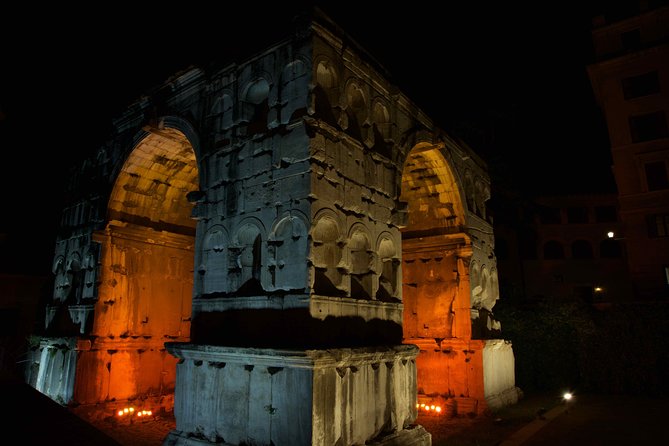
Rome after dark is a different city. This seven-hour workshop with photographer-guide Giulio D’Ercole takes you from a 10pm meeting at Castel Sant’Angelo through quiet squares, ancient ruins, and famous fountains, finishing with early light near St. Peter’s. You get Rome without the daytime crush and plenty of time to work on real photographs.
I especially like the maximum of four people, which gives Giulio room to help with your camera, and the private car, which makes twelve stops possible in one long night. The main drawback is the hour: you must stay alert until dawn, and the experience depends on good weather.
What makes this Rome night workshop special
- You photograph Rome from 10pm into sunrise, watching the city’s light change from night to blue hour and then early morning.
- Giulio teaches as you shoot, covering manual mode, ISO, aperture, shutter speed, white balance, long exposures, and light balance.
- The group is capped at four people, so advice can be tailored to your camera and skill level.
- Private transportation connects the stops, with short walking sections at the monuments and squares.
- The route mixes famous sights with less obvious settings, including Isola Tiberina, Teatro di Marcello, and the narrow streets of Rione Parione.
- You may rent Nikon camera equipment and a tripod for 50 euros per kit, payable in cash, if you arrive without your own gear.
Why Rome looks better after 10pm
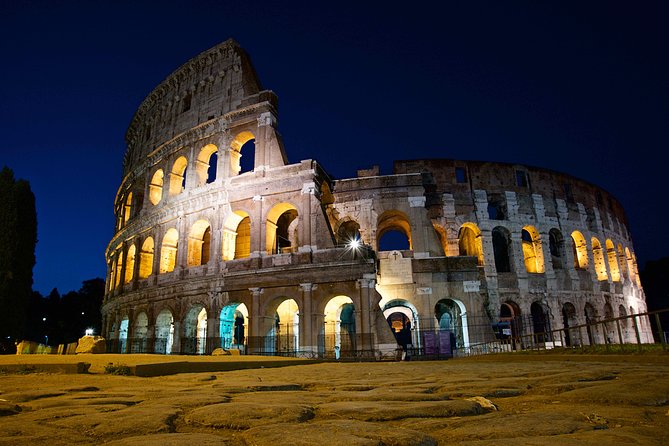
Most visitors see Rome in daylight, often surrounded by tour groups, traffic, and people taking the same quick snapshot. This experience works on the opposite schedule. You begin when many monuments are quieter, and you can think about framing instead of simply trying to get an unobstructed view.
Night photography also gives you useful problems to solve. A dark street beside a lit church, a bright fountain against black sky, or a floodlit ruin requires choices about exposure and focus. Giulio’s teaching is built around those choices. You practice rather than sit through a camera lecture.
The workshop is suited to a passionate beginner or an intermediate photographer. You do not need to be an expert, but you should be ready to use manual mode. If you normally point, press, and accept the camera’s decision, this is a good setting to learn why your images look too dark, too bright, blurry, or oddly colored.
You will work with:
- Manual exposure and ISO control
- Aperture and shutter speed
- White balance under mixed night lighting
- Long exposures using a tripod
- Leading lines, symmetry, foreground detail, and layers
- The changing quality of light before and after sunrise
- Real-time corrections while setting up each image
The optional image review after the tour is useful if you want more than a night out with a camera. You can submit photographs for detailed critique and suggestions. That follow-up is especially valuable because night photography often looks promising on the camera screen but reveals problems when viewed later.
More Photography Tours in Italy
- Rome: Vespa Photo Tour with Historic City Highlights
★ 5.0 · 395 reviews - Rome: Vespa Photo Tour with City Center Pickup
★ 5.0 · 239 reviews - Rome Night Photo Tour
★ 5.0 · 109 reviews
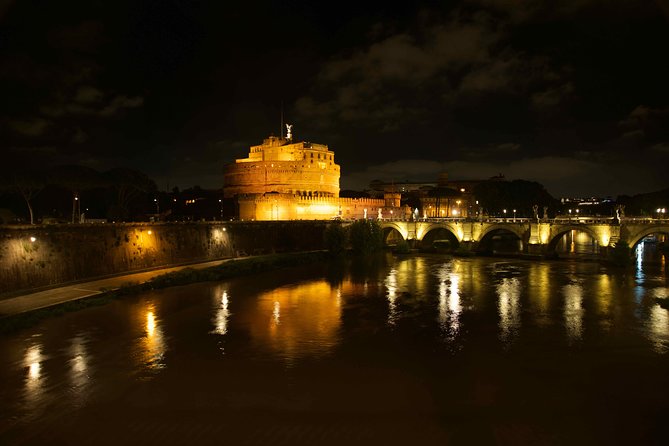
Starting at Castel Sant’Angelo
The official meeting point is at the entrance of Castel Sant’Angelo, opposite the Bridge of Angels on Lungotevere Castello. Pickup can also be arranged from your hotel, Airbnb, or home upon request.
Starting here gives the night a strong first subject. The castle, river, and bridge offer stone textures, repeating lines, and reflected light. It is also a practical meeting place for the private vehicle before the route begins.
Bring your camera with a charged battery and enough card space. A tripod is important for long exposures. If you have no camera, Giulio offers Nikon equipment and tripods for 50 euros per kit, paid in cash. Confirm that arrangement before the evening so you know what will be ready for you.
Twelve stops, with a photographer’s eye
The route covers a lot of ground. Private transportation matters here. Without it, twelve locations over roughly seven hours would mean too much walking and too little time with the camera. At each stop, you should expect a mix of positioning, camera setup, shooting, and moving on.
Piazza del Campidoglio
Michelangelo’s Piazza del Campidoglio is a fine place to start working on composition. Its designed geometry gives you symmetry, strong lines, and a central perspective. Night lighting can bring out the pale stone while leaving the surrounding space dark.
This is a useful early exercise because Giulio can help you decide how much of the square belongs in the frame. A wide view shows the architecture, while a tighter composition can focus on patterns and steps.
More Photography Tours in Rome
- Unique Rome by Night, Photo Tour and Workshop Under the Stars
★ 5.0 · 96 reviews - Vespa Rome Photography Tour by Local
★ 5.0 · 67 reviews - Rome by Day, Beauty and History Unique Photo Tour and Workshop
★ 5.0 · 36 reviews - Rome: Fiat 500 Vintage Photo Tour
★ 5.0 · 26 reviews
The Pantheon
The Pantheon offers a bold, rounded facade and a deep entrance that can create strong contrast after dark. Look for the play between the lit columns and the shadowed portico.
The square outside can be busy at other times of day, so the late hour helps you work without constant interruptions. Still, it is an active central location, and you may need patience if people remain nearby.
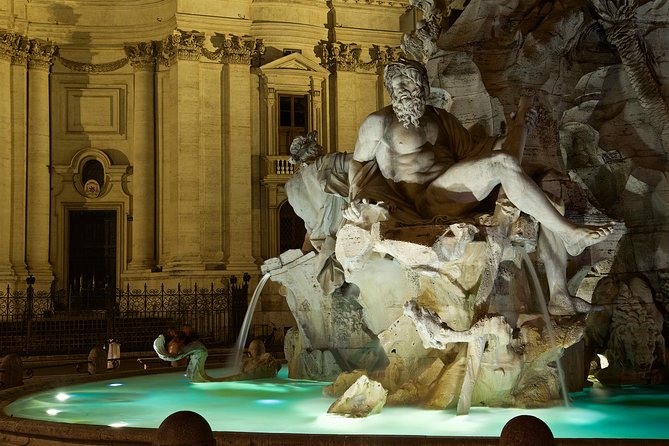
Piazza Navona
Piazza Navona is a natural place to practice balance between architecture, sculpture, open space, and artificial light. Its long shape lends itself to leading lines, while the fountains give you points of focus.
A night image here can easily become too bright around lamps and too dark in the corners. That makes it a practical lesson in exposure and white balance, not just a chance to photograph a famous square.
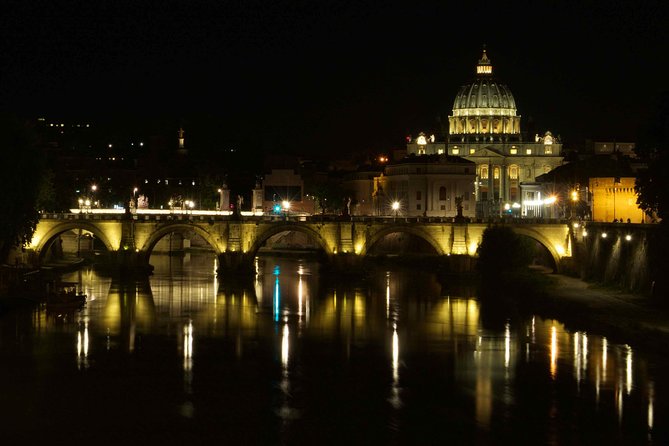
Castel Sant’Angelo
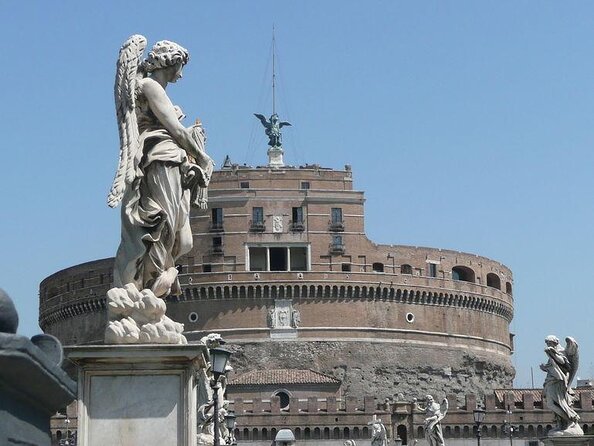
Although the tour begins at the castle, it also appears in the route as a major photographic subject. Its heavy cylindrical form looks dramatic at night, especially with the river and bridge nearby.
The area offers several ways to frame the monument. You might work from the riverfront, use the bridge as a line into the image, or include the surrounding darkness to make the illuminated structure more prominent.
St. Peter’s Square
St. Peter’s Square is one of the strongest locations on the route. The colonnade, central axis, and scale give you room to practice symmetry and centered compositions.
The timing is important. According to the tour description, the final Vatican-area photographs may be made around sunrise. That lets you capture the square in more than one mood, from artificial night lighting to the cooler tones of early morning.
One family found that the stories and camera guidance kept a nine-year-old engaged through the night. That does not make this a children’s tour in the usual sense, but it shows that Giulio can keep the evening conversational and active for a mixed-age group.
Teatro di Marcello
Teatro di Marcello gives you an ancient Roman structure in a quieter setting than the biggest headline sights. Its curved stonework and layered construction are well suited to night photographs.
This stop also helps break up the route. You are not simply collecting the same type of image at one grand square after another. The changing textures and shapes encourage you to adjust your composition.
Piazza Venezia
Piazza Venezia brings scale, traffic, monuments, and broad urban views into the workshop. It can be a harder place to photograph because artificial light, moving vehicles, and open space create competing subjects.
That challenge is useful. Giulio can help you decide where to place the brightest area in the frame and how to keep the image from becoming visually confused. If you prefer quiet scenes, this may be one of the less relaxed stops.
Isola Tiberina
The island in the Tiber offers a change of pace and a different relationship with Rome. Water can add reflections, while bridges and river edges give you foreground lines.
This is a good location for testing longer exposures. A tripod helps keep buildings sharp while allowing the water and passing light to register differently. The river also gives you a chance to work with negative space instead of filling the entire frame with monuments.
Rione Parione
Rione Parione brings you into Rome’s narrower streets and local urban texture. Here, composition is less about a single grand building and more about doors, walls, lamps, alleys, and layers of light.
Giulio is a Roman guide, and that local familiarity matters most in places like this. The value is not just finding an address. It is knowing how to move through the city and where a side street might offer a better angle than the obvious viewpoint.
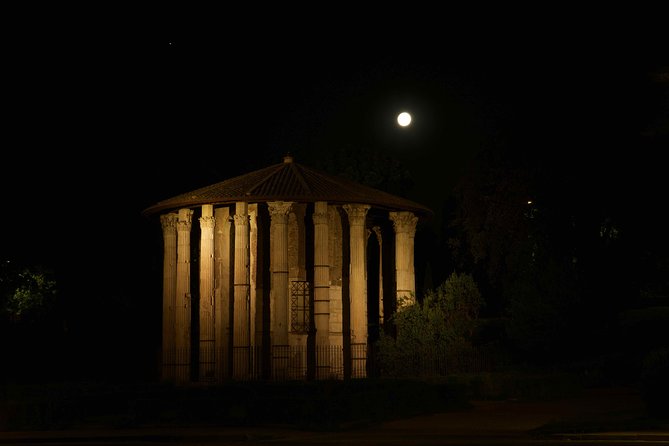
Tempio di Vesta
The Temple of Vesta adds a small ancient form against the much larger story of Rome. Its circular shape and surviving columns can be framed tightly, or placed within the surrounding archaeological area.
This stop rewards restraint. You may get a stronger image by leaving dark space around the temple rather than trying to show everything. It is another chance to discuss foreground interest and visual balance.
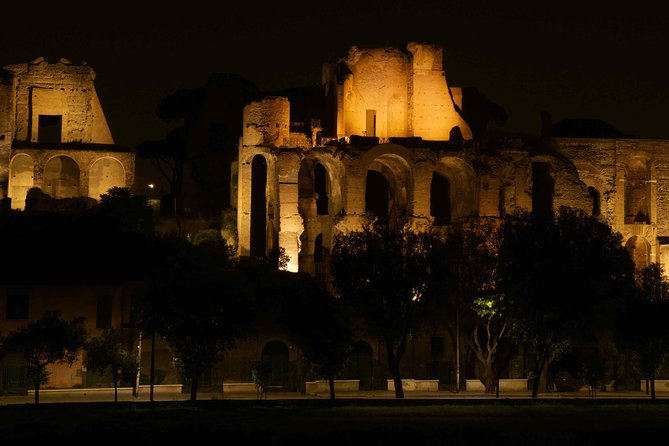
Terme di Caracalla
The Baths of Caracalla offer massive walls, arches, and open space. Even without daytime detail, the ruins can look imposing when lit at night.
The scale can tempt you into very wide photographs. Giulio’s guidance can help you find smaller compositions within the ruins, such as an arch framing another wall or a line of masonry leading toward the dark sky.
Fontana di Trevi
Trevi Fountain is a grand finale in terms of subject matter, with flowing water, carved stone, and bright illumination. It is also one of the most popular places in Rome, so the late-night timing is a real advantage.
Water and long exposures work naturally together here. You can learn how shutter speed changes the look of the fountain, while aperture and ISO affect the surrounding architecture and lights. Even at a quiet hour, do not expect total solitude. The fountain is too famous for that.
Learning instead of collecting snapshots
The strongest part of this experience is the coaching while you are making photographs. A guide who simply drives you to viewpoints would not justify the price. Giulio’s role includes helping with tripod placement, settings, framing, and the small corrections that make a photograph more deliberate.
You can ask for help with the technical basics, including:
- Why a lower ISO may improve image quality but require a longer exposure
- How aperture affects light and visual focus
- When a slow shutter speed helps and when it creates blur
- How white balance changes under streetlights and monument lighting
- How to use symmetry without making every image feel stiff
- How to place foreground objects and leading lines
- How the same subject changes as the sky lightens
The one-to-four ratio is important. In a large class, you might wait while someone else works through a camera problem. Here, the pace should be more personal, though you will still share time with the other participants if the tour is not booked privately by you.
The seven-hour schedule and its real cost
The price is $420.08 per person. That is a serious spend, especially because meals, camera rental, and any personal expenses are not included. The value depends on how much you want instruction rather than simple sightseeing.
You are paying for roughly seven hours, a professional photographer-guide, private transportation, a small group, and access to a carefully timed route. You also get a chance to photograph Rome during hours when daytime tour groups are not filling the main views. For someone building photography skills, that combination can be worthwhile.
For someone who only wants attractive holiday pictures, the price is harder to defend. You may get good images, but the workshop is designed to teach you how to make them. You should be comfortable spending the night adjusting settings, moving a tripod, and trying a shot again.
The schedule also has a physical and mental cost. You start at 10pm and continue toward dawn. Most of the route is by car, but the itinerary is covered both on foot and by vehicle. Wear comfortable shoes and bring a layer suitable for a long night outside. Those are practical suggestions for the hours involved, not promises about the weather.
Who should book it
I would choose this experience for a photographer who wants instruction tied to real places. It is especially good for:
- Beginners ready to leave auto mode
- Intermediate photographers who want stronger night images
- Solo visitors who want personal camera help
- Couples or families who prefer a small private setting
- Anyone who values quiet monuments more than daytime energy
- Photographers who want a portfolio of Rome images beyond standard daytime views
It is less suitable if you dislike late nights, want a relaxed sightseeing tour, or prefer to spend most of your time inside museums and monuments. The focus is photography, not entry to attractions. You will see and photograph the exteriors and surrounding areas on this route.
The tour has a maximum of four people, and most people can participate. It is offered in English. Group discounts are available, and the booking tends to be made well in advance, with an average lead time of 89 days. If this is a priority for your Rome trip, I would not wait until the last week.
Free cancellation is available up to 24 hours before the start time. Changes made within 24 hours are not accepted, and poor weather can lead to a new date or a full refund. Since rain and cloud can change the entire point of a night photography workshop, that weather rule is sensible.
Should you book this Rome photo tour?
Book it if you want to learn by doing and the thought of photographing Rome from late night into dawn sounds better than sleeping through those hours. Giulio’s patient, hands-on approach, the small group, and the private vehicle make the ambitious route workable.
Skip it if you are mainly looking for a cheap city tour or a few quick portraits. The $420.08 price, long schedule, possible camera rental cost, and weather dependence all matter. For a serious beginner or intermediate photographer, though, this is a focused way to see Rome at its quietest and return home with skills that last longer than a standard sightseeing snapshot.
FAQ
Where does the tour start?
It starts at the entrance of Castel Sant’Angelo, opposite the Bridge of Angels on Lungotevere Castello, 50, 00193 Rome.
Can I request hotel pickup?
Yes. Pickup can be requested from your hotel, Airbnb, or home. Otherwise, you meet at Castel Sant’Angelo.
What time does the experience begin?
The start time is 10:00pm.
How long does the photo workshop last?
The experience lasts approximately seven hours and finishes back at the meeting point.
How many people can join?
The maximum group size is four travelers.
Can I rent a camera and tripod?
Yes. Nikon camera equipment and tripods are available to rent for 50 euros per kit, payable in cash.
What happens if the weather is poor?
The experience requires good weather. If it is canceled because of poor weather, you will be offered another date or a full refund.
More Photography Workshops and Lessons in Rome
- Paris Photography Masterclass – Private Photography Lesson
★ 5.0 · 112 reviews - 2-Hour Photography Class While Touring Downtown Santa Fe, Smart Phones Welcome!
★ 5.0 · 108 reviews - Elevate Your Photography – Barcelona Private Tour & Workshop
★ 5.0 · 78 reviews - Private (Phone) Photography Class in Park & Old Town
★ 5.0 · 53 reviews
More Photography Workshops and Lessons in Italy
- Rome Photography Masterclass – Private Photography Lesson
★ 5.0 · 67 reviews - Rome: Night Photo Tour and Workshop
★ 5.0 · 2 reviews - Venice Photography Masterclass – Private Photography Lesson
★ 5.0 · 46 reviews - Photo workshop in Venice with a local photographer!
★ 4.6 · 3 reviews
Just added around Rome
- Rome: Vespa Tour with Professional Photographer★ 5.0 · 17 reviews
- Rome: Vintage Car Tour with Professional Photographer★ 5.0 · 19 reviews
- Rome: Vespa Tour with Professional Photoshoot as Passenger★ 5.0 · 22 reviews
- Rome: Vespa Scooter Night Tour with Pro Photographer service★ 5.0 · 24 reviews
- Rome: Retro Fiat 500 car tour with Pro-Photographer★ 5.0 · 7 reviews
- Vespa Tour with Professional Photography in Rome★ 5.0 · 6 reviews
- Rome: Fiat 500 Vintage Photo Tour★ 5.0 · 26 reviews
- Rome Vespa: Photos, City Highlights, Sightseeing by Vespa★ 5.0 · 36 reviews
Photography Workshops & Lessons, side by side.
Paris Photography Masterclass – Private Photography Lesson
Read our review →
2-Hour Photography Class While Touring Downtown Santa Fe, Smart Phones Welcome!
Read our review →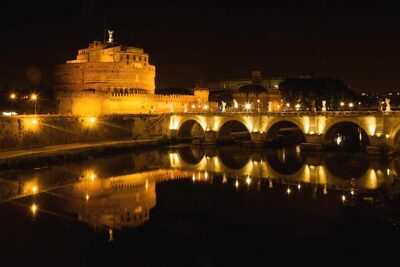
Unique Rome by Night, Photo Tour and Workshop Under the Stars
Read our review →
Elevate Your Photography – Barcelona Private Tour & Workshop
Read our review →
Rome Photography Masterclass – Private Photography Lesson
Read our review →
Private (Phone) Photography Class in Park & Old Town
Read our review →
Venice Photography Masterclass – Private Photography Lesson
Read our review →