Review · NIGHT & ASTRO PHOTOGRAPHY
Private Night Photography Tour in London
London looks entirely different after dark, and this tour puts the camera in charge. You’ll work with city lights, river reflections, passing boats, and streams of car lights while David shows you how small changes in settings can transform a night shot. The London Eye is a fine opening subject, especially for light trails and creative effects.
I like two things here: you can use a DSLR, Canon, Fuji, or iPhone, and the instruction is practical rather than purely scenic. I also like the mix of famous views and tucked-away angles around the City of London. The main consideration is equipment: a tripod is important for the long exposures, and the advertised duration varies between about 2 hours 30 minutes and three hours.
Key points
- Learn with any camera: DSLR, mirrorless camera, or smartphone skills are welcome.
- Practice real night techniques: Work on long exposures, light trails, reflections, multiple exposures, and zoom effects.
- Photograph four major areas: The London Eye, St Paul’s Cathedral, the City of London, and Tower Bridge.
- Get personal instruction: Professional photographer David adjusts advice to your camera and experience level.
- Keep learning afterward: The photography e-guidebook helps you repeat the techniques on your own.
- Check the group setup: The experience is sold as private, but confirm the exact arrangement when booking.
Why London at night works so well for photography
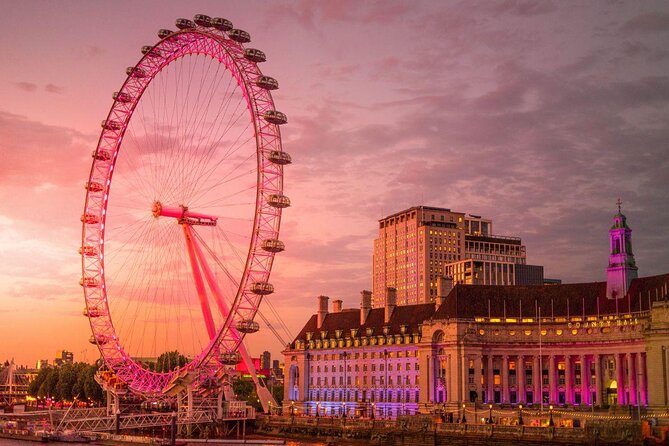
After sunset, London gives you several subjects in one compact outing. The city lights provide bright points and reflections. Traffic supplies moving lines. Boats on the Thames can turn into soft streaks during a long exposure. Landmark buildings give your frame a clear anchor.
That makes this more useful than a simple evening sightseeing walk. You are not just being taken to a viewpoint and told to take a picture. You are shown how to control what the camera records.
A beginner may learn the basics of shutter speed, aperture, focus, and camera controls. An experienced photographer may try multiple exposure shots, intentional zooming during a long exposure, or new ways to frame familiar buildings. The point is not to copy one postcard image. It is to help you find your own version of London after dark.
The guide, David, is both a professional photographer and an instructor. His role is especially valuable when your camera does something you have never tried. One participant discovered that their camera could create multiple exposures. Another used a zoom effect during a long exposure to produce an unusual burst of light. Those are the sorts of discoveries that can keep paying off long after the tour ends.
More Photography Tours in London
- Private Tour: Night Photography Tour in London
★ 5.0 · 48 reviews - Photography Tour walking the back streets of London’s West End (3 hours)
★ 5.0 · 24 reviews - London Photography Tour – Private Tour
★ 5.0 · 17 reviews
Meeting at Portcullis House
The tour begins at Caffè Nero, Unit B, Portcullis House, 1-2 Bridge Street, London SW1A 2JH. This is near Westminster, a sensible starting point for an evening focused on the Thames and central London landmarks.
Arrive ready to begin. You will want your camera charged, your memory card cleared, and your preferred camera settings easy to reach. If you use a smartphone, make sure you know where the night mode and exposure controls are before meeting David. If you use a DSLR or mirrorless camera, bring the lenses and accessories you normally use for city photography.
The activity ends back at the meeting point. The supplied details do not include food or drinks, so plan around the tour if you need dinner or a snack. This is also not a sitting exercise. You should expect a moderate level of walking and enough time on your feet to move between viewpoints.
The tour is listed at about 2 hours 30 minutes, while the description also refers to a three-hour night tour. That small difference matters if you are arranging dinner, a show, or late transport. Allow a full three-hour window and confirm the precise timing before you book.
Stop one: the London Eye and the first light trails
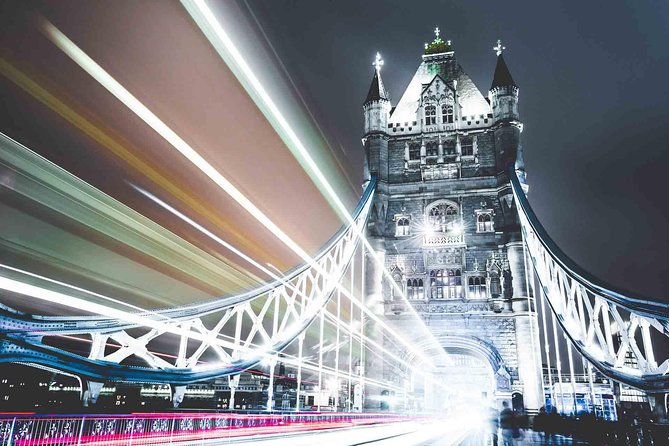
The London Eye is an excellent place to start because it gives you a large, recognizable subject with plenty of light. Its capsules, structure, and surrounding illumination can all work in a night composition.
This is where you begin to see how exposure changes the picture. A short exposure can freeze detail. A longer one can soften movement and create light trails. You might also work with creative effects rather than aiming for a perfectly sharp record of the wheel.
David’s instruction is built around demonstration and practice. He can show a setting, explain what it changes, and then give you time to try it yourself. That approach suits a first-time night photographer because you are not expected to arrive knowing manual controls.
The river adds another layer. Reflections from the London Eye and nearby lights can give a picture balance, while movement on the Thames can add soft lines across the lower part of the frame. You will need to watch your composition carefully. Bright lights can dominate a small frame, so changing your angle or position may matter as much as changing the camera settings.
Stop two: St Paul’s Cathedral and long exposure control
St Paul’s Cathedral gives you a different kind of subject. Instead of a circular structure and moving capsules, you get a grand architectural form with strong lines and a clear central focus.
This is a good place to practice keeping a building sharp while controlling the light around it. Long exposures can make passing traffic appear as smooth lines, but they also magnify camera shake. That is why a tripod matters so much on this tour.
If you do not own one, ask ahead about equipment. David has brought a spare tripod for a participant who arrived without one after an airline lost their luggage. That was useful, but sharing a tripod reduced flexibility. You may still get good pictures, but your own tripod lets you set up when you want and repeat a shot without waiting.
St Paul’s is also a good reminder that night photography is not just about turning the exposure time up. You may need to adjust focus, manage bright areas, and decide how much surrounding street activity belongs in the frame. David can help you work through those choices rather than handing you one fixed recipe.
More Photography Tours in the UK
- London: Iconic Sights Photo Walking Tour
★ 4.9 · 12 reviews - Iconic London Photo Walking Tour
★ 4.6 · 11 reviews - Night Photography Tour in London
★ 5.0 · 4 reviews - A Professional Photo Walk Experience in London
★ 5.0 · 4 reviews
Stop three: the City of London and less obvious angles
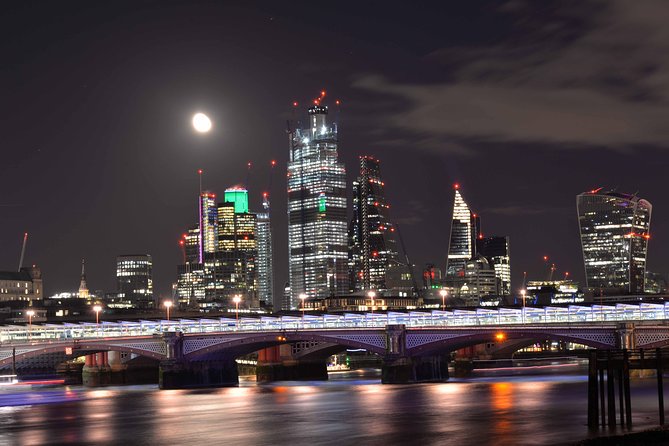
The City of London adds variety. Here, the goal is not only to photograph a famous landmark straight on. You may look for unusual viewpoints, narrow openings between buildings, reflections, and smaller details that give a familiar district a personal feel.
This part is especially useful for anyone who already knows basic camera operation. You can test your own ideas while David suggests ways to improve framing or use the available light. Beginners can also benefit because the setting shows how to find a worthwhile photograph without waiting for a major monument.
The City provides opportunities for moving subjects too. Car lights can become bright lines, and passing people or vehicles can add scale. The trick is timing. A long exposure can make movement look deliberate, but too much activity can muddy the image. You will learn through trial and adjustment.
Phone photographers are not left behind here. Modern smartphones can handle night scenes well when you use the right mode and keep the phone steady. David has taught participants how to use iPhones for creative nighttime shots, including framing and exposure choices that also apply during the day.
Stop four: Tower Bridge and the Thames
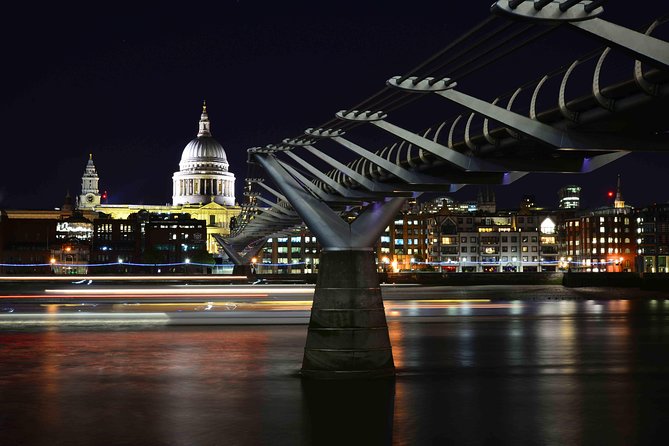
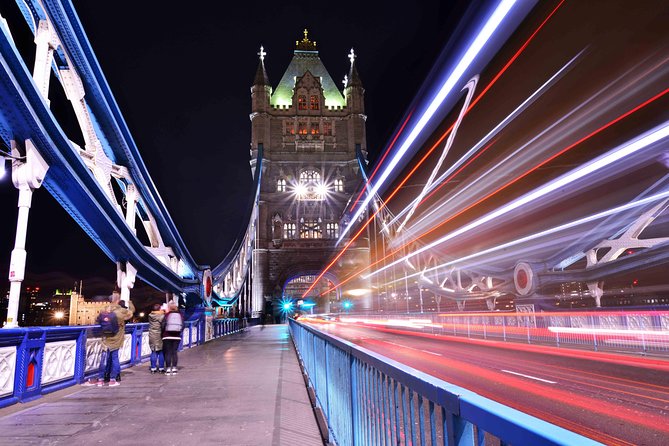
Tower Bridge is the big finale. Its towers, suspension lines, and river setting create several strong compositions, especially when the surrounding lights reflect in the water.
This is where the tour’s subjects come together. You can work with architecture, reflections, moving traffic, and boats. A long exposure may turn a passing boat into a blurred streak while keeping the bridge recognizable. Traffic can create red and white lines along the roadway. Reflections can double the visual impact, though wind or choppy water may change the result.
Do not expect every frame to work. Night photography often requires several attempts, and the tour gives you a chance to learn from the misses. You may need to adjust the position of the tripod, alter the shutter speed, or wait for a better pattern of traffic and boats.
Tower Bridge is also a useful place to think about balance. The bridge can fill the frame, but leaving room for the Thames and its reflections may produce a stronger image. David can suggest angles that avoid the most obvious postcard view and help you make a picture that feels more like your own.
What David teaches during the walk
The best part of the experience is the direct practice. David demonstrates techniques, then helps you apply them with your own camera. That distinction matters. A general photography talk may explain long exposure in theory, but you need to find the setting on your particular camera before the lesson becomes useful.
The instruction can include:
- Manual camera controls and low-light settings
- Long exposures for traffic, boats, and light trails
- Tripod use and reducing camera shake
- Framing major landmarks from less common angles
- Reflections along the Thames
- Multiple exposure functions
- Zoom effects during a long exposure
- Smartphone night photography
- Small setting changes that affect the final image
David is familiar with many camera brands, but he may not know every menu system in detail. That is not a serious issue if you already know how to operate your camera. If you are new to your equipment, spend a few minutes reviewing the basics before the tour. It will leave more time for photography instead of menu hunting.
The guide’s teaching style also appears suited to mixed ability levels. Beginners can learn the fundamentals, while hobbyists can explore creative effects. Experienced photographers should not expect a highly technical masterclass tailored to one advanced camera system, but they can still gain new ideas for shooting London at night.
DSLR, mirrorless camera, or smartphone?
You do not need a professional camera. The tour is specifically designed for different types of equipment, including smartphones.
A DSLR or mirrorless camera gives you more control over shutter speed, aperture, focus, and lens choice. It is the best fit if you want to work seriously with long exposures and manual settings. A tripod will make this setup far more effective.
A smartphone is easier to carry and can produce excellent results when used carefully. David can show you how to control the phone, use night features, and find a steady composition. The phone may not offer the same manual control as a dedicated camera, but it is more than capable of recording the London Eye, St Paul’s, and Tower Bridge in low light.
Bring the camera you actually want to use on your trip. There is little value in borrowing complicated equipment that you cannot operate comfortably. You will learn more by making small adjustments on a familiar device.
The private format and group question
The experience is described as a private activity, with only your group participating. That should mean a more personal pace and more time for your own questions than a large public tour.
At the same time, the tour information uses group language, and a detailed account describes three participants working together. Because of that inconsistency, I would confirm the exact group arrangement with Sky Blue Photography before paying, especially if private instruction is the main reason you are booking.
The size matters for photography. A smaller group makes it easier to set up tripods, ask about a particular camera, and choose when to move on. A slightly larger group can still work well, but you may share equipment or wait while others make adjustments.
Group discounts are available, which may improve the price for a family or a few friends. Just remember that discounts do not necessarily mean one-on-one teaching. Ask what the discount covers and how many people can join.
Is $164.52 per person good value?
At $164.52 per person, this is not a cheap sightseeing walk. You are paying for a professional guide, photography instruction, access to several major London views, a photography e-guidebook, and group photos.
The value depends on your aim. If you only want a few snapshots of Tower Bridge, you can visit these areas yourself for far less. If you want to learn how to make better night images and plan to use those skills again, the price is easier to justify.
The practical benefit is transferability. A lesson on exposure, stability, focus, or framing can help you photograph city streets, family scenes, and landscapes at home. The e-guidebook gives you something to consult after the evening, so the instruction does not end when you leave the meeting point.
The tour also saves you the work of finding several viewpoints yourself. You get an organized route through central London, with time spent on photography rather than trying to work out where the best angles might be.
Who should book this evening tour?
I would recommend it to:
- Beginners who want friendly help with camera settings
- Smartphone users who want stronger night pictures
- Hobby photographers visiting London with a DSLR or mirrorless camera
- Couples or small groups who want a guided creative activity
- Photographers interested in light trails, reflections, and long exposures
- Anyone who prefers learning by trying rather than sitting through a lecture
It may be less suitable if you dislike walking, do not want to carry a camera or tripod, or have no interest in learning technique. It is also not the best fit for someone seeking a fast landmark tour with only a few minutes at each stop.
Bring charged batteries. One participant’s camera battery died, but switching to an iPhone kept the lesson going. That is a useful reminder to carry a backup device if you have one. London weather can also change quickly, so pack for rain. An umbrella was purchased during one wet evening, but you should not count on that happening every time.
Cancellation is free up to 24 hours before the start time for a full refund. Changes or cancellations made less than 24 hours before the start time are not accepted for a refund. The cut-off follows London local time.
My verdict on the London night photography tour
Book this if you want more than a collection of standard London snapshots. David’s practical instruction, the mix of camera types, and the chance to work with traffic, boats, reflections, and landmark lights give the evening real purpose.
The strongest value comes from the skills you take home. You can use the same ideas on your next city break, with your own family photos, or whenever you want to make an ordinary street look more intentional.
I would confirm the exact duration, group size, and tripod arrangements before booking. With those details clear, this is a strong choice for beginners and hobby photographers who want to see London at night while learning how to control the camera.
FAQ
How long does the tour last?
The stated duration is approximately 2 hours 30 minutes. The experience description also refers to a three-hour tour, so allow up to three hours and confirm the exact timing before booking.
Where does the tour start?
It starts at Caffè Nero, Unit B, Portcullis House, 1-2 Bridge Street, London SW1A 2JH, UK.
Where does the tour finish?
The activity ends back at the meeting point.
Is the tour private?
It is described as a private activity for your group. Since the details also use group language, confirm the exact arrangement with the provider if private instruction is essential to you.
What camera can I bring?
You can bring a DSLR, mirrorless camera, or smartphone. The tour is designed for different types of cameras.
Do I need a tripod?
A tripod is strongly useful for the long exposures covered during the tour. Ask the provider about tripod arrangements if you do not have one.
Which London sights are included?
The route includes the London Eye, St Paul’s Cathedral, the City of London, and Tower Bridge. The photography also includes Thames reflections, car light trails, and passing boats.
Is food included?
No. Food and drinks are not included unless specifically stated.
Is the tour suitable for beginners?
Yes. The instruction covers camera controls and night photography basics, while more experienced photographers can work on creative effects and unusual compositions.
What is included with the booking?
A photography e-guidebook, the tour, and group photos are included.
More Private Photoshoots in the UK
- London: Private travel vacation photoshoot -Romantic Special
★ 4.7 · 50 reviews - Professional Private Couple Photoshoot
★ 5.0 · 35 reviews - London: Private Couples Photography Session with Landmarks
★ 5.0 · 16 reviews - London: Private Photo Session in Westminster
★ 4.9 · 16 reviews
More Private Photoshoots in London
- London: Private Photoshoot with Video Clip Option
★ 4.8 · 182 reviews - Private landmarks photoshoot for families and couples
★ 5.0 · 92 reviews - London: Private Landmark Tour with Professional Photographer
★ 4.7 · 91 reviews - Professional Private Photoshoot in London
★ 5.0 · 63 reviews
Just added around London
- London: Professional Private Photoshoot and Edited Photos★ 5.0 · 4 reviews
- London Photoshoot 1 Hour – Customisable★ 5.0 · 40 reviews
- photoshoot London memories★ 4.2 · 6 reviews
- Photoshoot at Notting hill,Covent Garden,St Paul Cathedral★ 4.4 · 12 reviews
- Night Photography Tour in London★ 5.0 · 4 reviews
- London: A Unique Photoshoot Experience at Famous Sites★ 4.6 · 22 reviews
- London: West End Photography Walking Tour with Guide★ 5.0 · 2 reviews
- London: Private Photo Session at Iconic Landmarks★ 5.0 · 6 reviews
Night & Astro Photography, side by side.
Tokyo by Night Photography Tour (Private Option Available)
Read our review →
Night Photo Session in a Fiat 500 with Aperol Spritz
Read our review →
Private Guided Night Photography Tours on Cape Cod (for one photographer.)
Read our review →